

How does a counter - flow seawater cooling tower work?
Jun 25, 2025
Hey there! As a supplier of Seawater Cooling Towers, I'm super excited to take you on a journey through how a counter - flow seawater cooling tower works. It's an amazing piece of technology that plays a crucial role in many industries, and I'm here to break it down for you in an easy - to - understand way.
Let's start with the basics. A counter - flow seawater cooling tower is a device used to cool down hot water by transferring heat to the atmosphere. It's commonly used in power plants, refineries, and other industrial facilities where a large amount of heat needs to be dissipated.
The Main Components
First off, we've got the fill media. This is like the heart of the cooling tower. The fill media provides a large surface area for the hot water and the air to come into contact. When the hot water is distributed over the fill media, it forms a thin film, which allows for efficient heat transfer. The more surface area there is, the better the heat transfer will be.
Next, we have the water distribution system. This system is responsible for evenly spreading the hot water over the fill media. There are different types of water distribution systems, but the most common ones use nozzles to spray the water downwards. This ensures that the water is distributed evenly across the fill, maximizing the contact between the water and the air.
Then, there's the air inlet. The air inlet is where the cool air enters the cooling tower. In a counter - flow cooling tower, the air moves upwards while the water moves downwards. This counter - flow arrangement is really important because it creates a large temperature difference between the hot water and the cool air, which enhances the heat transfer process.
The fan is another key component. The fan is used to draw the cool air into the cooling tower and force it upwards through the fill media. It helps to maintain a continuous flow of air, which is essential for the cooling process. There are different types of fans, such as axial fans and centrifugal fans, and the choice depends on the specific requirements of the cooling tower.
Finally, we have the drift eliminators. These are installed at the top of the cooling tower to prevent water droplets from being carried out of the tower by the exiting air. They help to reduce water loss and protect the surrounding environment from water pollution.
The Working Process
Now, let's dive into how all these components work together in the actual cooling process.
The hot water from the industrial process enters the cooling tower through the water distribution system. The nozzles spray the water downwards onto the fill media. As the water falls through the fill, it forms a thin film on the surface of the media.
At the same time, the fan draws cool air into the cooling tower through the air inlet. The air moves upwards through the fill media, in the opposite direction of the falling water. This counter - flow movement creates a large temperature difference between the hot water and the cool air.
Heat transfer occurs when the hot water comes into contact with the cool air. The heat from the water is transferred to the air, causing the water to cool down. As the water cools, some of it evaporates. Evaporation is a key part of the cooling process because it requires energy, which is taken from the water in the form of heat. This further reduces the temperature of the water.
The cooled water then collects at the bottom of the cooling tower in a basin. From there, it can be pumped back to the industrial process to be reused.
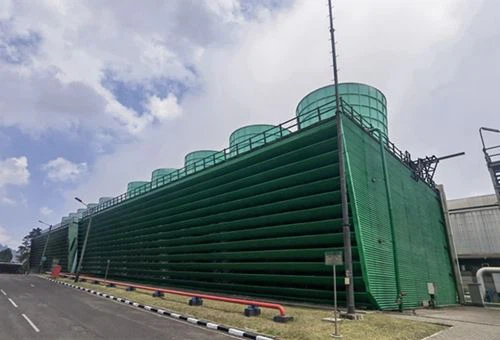

The air, which has now absorbed the heat and moisture from the water, rises to the top of the cooling tower. Before it exits the tower, it passes through the drift eliminators, which remove any water droplets that might be carried along with the air.
Advantages of Counter - Flow Seawater Cooling Towers
One of the biggest advantages of counter - flow seawater cooling towers is their high efficiency. The counter - flow arrangement allows for a greater temperature difference between the water and the air, which means more heat can be transferred in a shorter amount of time. This results in better cooling performance and lower energy consumption.
Another advantage is their compact design. Compared to other types of cooling towers, counter - flow cooling towers can achieve the same cooling capacity in a smaller footprint. This is especially important for industrial facilities where space is limited.
Seawater is also a readily available and cost - effective cooling medium. Using seawater in cooling towers can significantly reduce the demand for freshwater, which is a precious resource in many parts of the world.
Applications
Counter - flow seawater cooling towers are widely used in various industries. In power plants, they are used to cool the condenser water, which helps to improve the efficiency of the power generation process. In refineries, they are used to cool the process water, which is used in different stages of the refining process.
They are also used in chemical plants, where they help to cool the reactants and products, ensuring the stability and safety of the chemical reactions. And in desalination plants, counter - flow seawater cooling towers are used to cool the equipment and maintain the optimal operating conditions.
Our Products
As a Seawater Cooling Tower supplier, we offer a wide range of high - quality counter - flow seawater cooling towers. Our Industrial Counterflow Cooling Tower is designed with the latest technology to ensure maximum efficiency and reliability. We also have Concrete Crossflow Cooling Towers for those who need a more robust and durable solution. And of course, our Seawater Cooling Tower is specifically tailored to meet the unique requirements of using seawater as a cooling medium.
Contact Us for Procurement
If you're in the market for a seawater cooling tower, we'd love to hear from you. Whether you need a small - scale cooling tower for a specific application or a large - scale industrial solution, we have the expertise and the products to meet your needs. Don't hesitate to reach out to us for a detailed consultation and a customized solution.
References
- Pate, M. B., & Cullimore, B. R. (2009). Cooling tower performance: effects of drift eliminator fouling. HVAC&R Research, 15(4), 773 - 790.
- Wang, L., & Jin, H. (2013). Numerical simulation of heat and mass transfer performance in a counter - flow wet cooling tower. Applied Thermal Engineering, 54(1), 230 - 236.
- Rohsenow, W. M., Hartnett, J. P., & Cho, Y. I. (1998). Handbook of heat transfer. McGraw - Hill.