


Tianjin Latino Environmental Technology CO.,Ltd is a scientific-oriented economy body integrating with scientific research, designing, manufacturing, installation and service maintenance, which is originated from European.We, Tianjin Latino are specialized supply one stop service for the cooling tower parts and cooling tower engineer service.
Why choose us
Widely used
Tianjin Latino's cooling tower and cooling tower parts is widely used in the Petrochemical, Petroleum, Power, Metallurgy, Medicine and Rubber Industry, etc..
Extensive market
Our business involve in covers 64 countries and regions including the UK, Germany, Italy, Belgium, France, Poland, Israel, Russia, Turkey,UAE,IRAN, Malaysia,Philippines, Indonesia, Korea, Japan, Australia, Thailand, India, Singapore and New Zealand, Netherlands,Ukraine, etc..
Rich experience
We have more than 20 years of production experience in the industry.
Rich products
Tianjin Latino's main products are cooling tower, cooling tower Film Fill, cooling tower drift eliminator and cooling tower spray system, UPVC distribution pipes, FPR winding pipe, FRP profile parts,FRP gratings, Fan stack, etc.
-
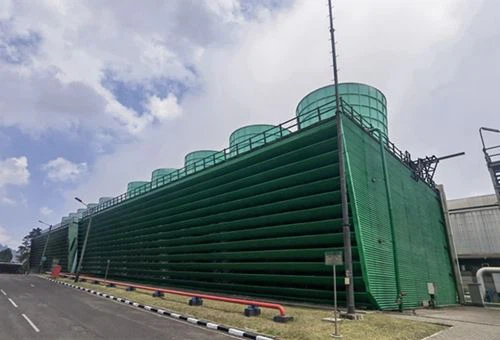
![Cross Flow Natural Draft Cooling Tower]()
Cross Flow Natural Draft Cooling Tower
Add to Inquiry -
![Industrial Counterflow Cooling Tower]()
Industrial Counterflow Cooling Tower
Add to Inquiry -
![Concrete Crossflow Cooling Towers]()
Concrete Crossflow Cooling Towers
Add to Inquiry -
![Seawater Cooling Tower]() Add to Inquiry
Add to Inquiry


Types of Industrial Cooling Tower
Natural draft cooling towers
As the name suggests, natural draft cooling towers rely on natural air convection to cool the incoming hot water. Cold, dry air flows naturally through the tower and comes into contact with the warm, moist air that has absorbed heat from the hot water stream. The warm air will then naturally flow up, while the cold air falls to the splash fill on the bottom of the tower.
Forced draft cooling towers
Forced draft cooling towers employ internal fans to circulate air through the structure to increase its cooling efficiency. Usually utilized in HVAC systems in data centers and commercial buildings, forced draft cooling towers are costlier to deploy and run than natural-draft cooling towers but are more suited for indoor facilities and smaller spaces.
Induced draft cooling towers
Like forced draft cooling towers, induced draft cooling towers employ fans to pull air through the tower. They are usually larger than forced draft cooling towers with fans on top of the tower.
Crossflow cooling towers
In this type of cooling tower design, the air flows vertically while the water flows horizontally, allowing for more effective heat exchange processes. Often utilized in industrial and commercial HVAC systems, crossflow cooling towers are more efficient than traditional ones but are also more expensive to build and maintain over time.
Counterflow cooling towers
Counterflow cooling towers are most suited for extensive industrial facilities like petrochemical plants. In these towers, the water flows down vertically while the air is pushed vertically across the splash fill from the bottom to the top of the structure. These towers are more frost-resistant than crossflow cooling towers, and they use a similar approach to accomplishing effective water-to-air heat exchange.
Application of Industrial Cooling Tower
Power plant: Cooling towers help cool circulating water used in condensers in power generation facilities.
HVAC: Commercial buildings, hospitals, schools and hotels use cooling towers for air conditioning systems to regulate indoor temperatures efficiently.
Industrial: Chemical processing, oil refineries, steel mills and manufacturing plants use cooling towers to maintain optimal temperatures for equipment and processes.
Data: Cooling towers help dissipate the heat generated by servers and IT equipment in data centers, preventing overheating and ensuring continuous operation.
Food and beverage: Food processing plants use cooling towers to cool equipment, ingredients and products during production processes.
Plastics: Injection molding and extrusion processes in the plastics industry often require cooling towers to maintain consistent temperatures for quality control.
Methods of Cooling Tower Assembly
Cooling towers have two main assembly methods. Factory employees may assemble the towers directly in the production factory and then ship them to their sites, or workers may assemble the towers at the sites.
Factory-assembled
In factory-assembled cooling towers, employees at the production factory put the tower together. Once it is complete, they transport it intact to the location that will use it. This preassembly process generally works best for smaller towers, since larger towers can become unwieldy to ship or sustain damage in transit.
Field-erected
If a cooling tower would be too large, fragile or difficult to ship, the receiving location may opt to erect it on site. In that case, the manufacturer or supplier generally provides the labor, and the workers usually build the tower close to the building where industrial processes take place.
Field-erected towers can make use of either crossflow or counterflow designs. Because they have few limits on their size and can be much larger, they are often useful in industrial applications that draw substantial amounts of power.
Feature
|
Item |
Specification |
|
Cooling tower type |
Counterflow cooling towers |
|
Fabrication |
Field-assembled |
|
Air flow |
Induced draft |
|
Capacity |
2,000,000- 20,000,000 kcal/h per cell |
|
Water flow |
400-4,000 cubic meter per hour for each cell |
|
Industries |
Chemical industries, Oil and Gas, Pharmaceutical, Power plant, Refineries, large-scale HVAC systems. |
1. Minimize in-house engineering time and knowledge for optimal product selection
2. Increase energy efficiency, boost performance and streamline your operation
3. Bundle components to simplify your purchasing and lower shipping and logistics costs.
4. Minimize downtime with products backed by industry leading availability.
5. Get ideas and insights from an expert who’s well versed in your industry and your application.
6. Incorporate intelligent solutions that automate ordering and provide real-time system performance data.
7. Integrate support, service, diagnostics, ordering and engineering-all from a single partner.
FAQ
As one of the most professional industrial cooling tower manufacturers and suppliers in China, we're featured by quality products and good price. Please rest assured to wholesale custom made industrial cooling tower from our factory. Contact us for more cheap products.
Cross Flow Natural Draft Cooling Tower manufacturers, industrial cooling tower design, industrial cooling tower in safety control systems